
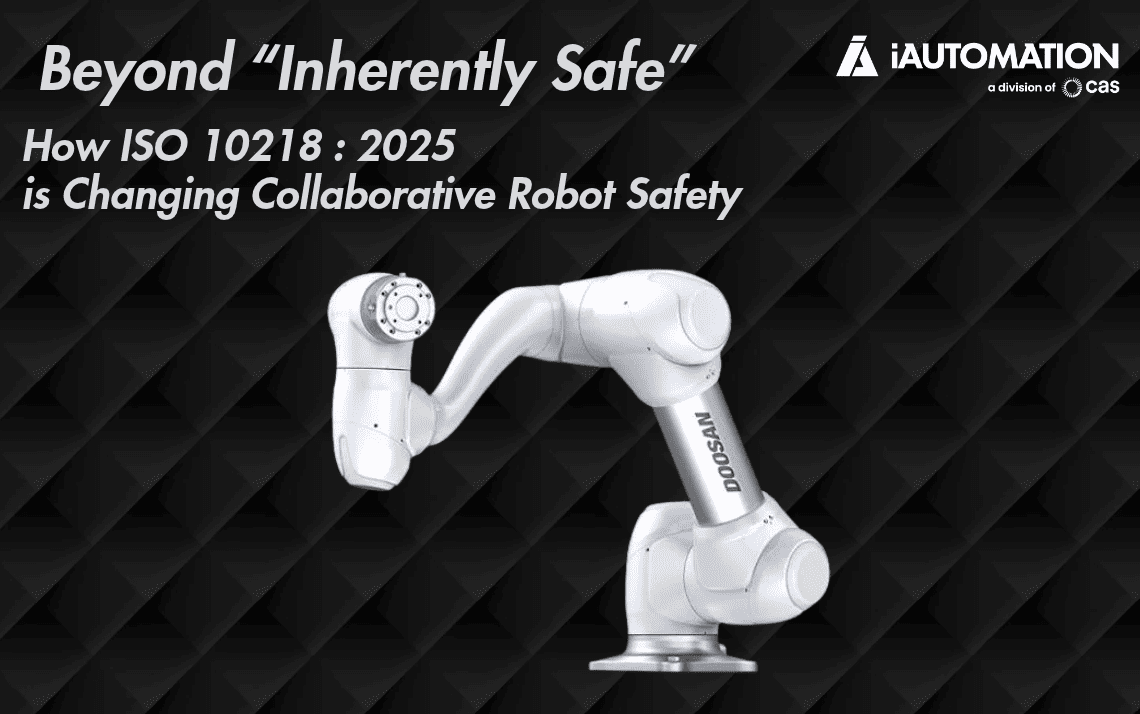
Industrial robotics has changed significantly over the last decade. Collaborative robots moved from niche applications into mainstream manufacturing, making it possible for humans and robots to work in closer proximity than ever before. As adoption increased, so did questions about how these systems should be evaluated, validated, and maintained from a safety perspective.
The latest updates to robot safety standards reflect that shift. ISO 10218:2025 and ANSI R15.06-2025 introduce some of the most substantial changes the robotics industry has seen in years. More importantly, they move the conversation away from the safety characteristics of an individual robot and toward the safety of the entire robotic application.
For manufacturers, system integrators, OEMs, and EHS teams, compliance is no longer limited to selecting a collaborative robot and assuming the application meets safety requirements. Validation, documentation, risk assessment, and even industrial cybersecurity are becoming central elements of robot safety compliance.
Understanding these changes now can help organizations avoid compliance gaps later while building safer and more reliable robotic systems.
What changed in the new robot safety standards?
Integration of ISO/TS 15066 into ISO 10218
One of the most notable updates in ISO 10218:2025 is the incorporation of guidance from ISO/TS 15066 directly into ISO 10218-2.
For years, ISO/TS 15066 served as the primary reference document for collaborative robot safety. It provided guidance on collaborative operation modes, force and pressure limits, and risk reduction measures when humans and robots share a workspace.
With that guidance now embedded directly into ISO 10218, collaborative applications are no longer treated as a separate consideration. They are part of the core robot safety framework.
This change reinforces an important point that many engineers have understood for some time: a collaborative robot is not automatically safe because it is labeled a cobot. Safety ultimately depends on how the robot is deployed within a specific application.
A robot may be designed for collaborative operation, but application-level risks still depend on factors such as:
- End-of-arm tooling
- Workpiece geometry
- Process hazards
- Operating speed
- Workspace layout
- Human interaction frequency
A collaborative robot handling sharp metal components presents a different risk profile than the same robot assembling plastic parts. The application must be evaluated as a complete system.
As a result, collaborative robot safety and human robot collaboration safety now require a more rigorous assessment process than many organizations have historically performed.
Power and Force Limiting (PFL) now requires validation
Power and Force Limiting (PFL) remains one of the most widely used collaborative operation modes. In a PFL application, the robot is designed to limit force, pressure, speed, or energy so that contact with a person does not create unacceptable injury risk.
Historically, many organizations relied heavily on manufacturer specifications when implementing PFL applications. Under the updated standards, that approach becomes harder to justify.
The expectation is shifting toward measurable validation and documented proof that force and pressure limits remain within acceptable thresholds during actual operation.
This means organizations may need to:
- Conduct physical force measurements
- Document testing procedures
- Maintain validation records
- Demonstrate compliance during audits or assessments
For engineers responsible for robot safety validation, this represents a major shift. Compliance increasingly depends on objective evidence rather than assumptions based on robot design specifications.
Tools such as Pilz’s PRMS (Pilz Robot Measurement System) provide one approach for collecting and documenting force measurement data during collaborative application validation. The goal is not simply to test a robot once but to establish repeatable evidence that the application operates within defined safety limits.
As cobot safety requirements continue to mature, force measurement and validation activities are likely to become routine components of collaborative robot deployments.
New robot classifications: Class I vs Class II
The updated standards also introduce revised robot classifications that influence how safety evaluations are performed.
Although the details vary depending on the application and deployment scenario, the new Class I and Class II distinctions help define different expectations regarding robot design characteristics, safety functions, and risk reduction strategies.
For safety professionals, these classifications create a more structured framework for robot risk assessment and compliance planning.
Rather than applying a single methodology to every robotic system, organizations must consider how robot classification affects:
- Hazard identification
- Risk estimation
- Required protective measures
- Validation requirements
- Compliance documentation
The practical result is that risk assessment becomes even more important. Engineers must understand not only the robot itself but also how its classification affects the broader safety strategy.
Organizations that rely on legacy risk assessments may need to revisit existing documentation to determine whether it aligns with current expectations under ISO 10218:2025 and ANSI R15.06-2025.
Cybersecurity is now part of robot safety
For the first time, industrial robot cybersecurity is being recognized as a safety consideration within the standards framework.
This reflects a reality that has existed in manufacturing environments for years. Modern robots are increasingly connected through industrial networks, remote access platforms, cloud-based monitoring tools, and integrated production systems.
When unauthorized users gain access to robotic systems, safety functions can potentially be altered, bypassed, or disabled.
Potential risks include:
- Unauthorized parameter changes
- Manipulation of safety settings
- Unapproved program modifications
- Credential misuse
- Remote access vulnerabilities
The standards now acknowledge that cybersecurity weaknesses can create safety consequences.
For manufacturers, this means cybersecurity should be included in both safety planning and risk assessment activities.
Access management technologies such as Pilz PITreader systems can help organizations establish controlled authentication procedures, user permissions, and secure access workflows. These controls support both cybersecurity objectives and broader robot safety standards compliance.
The message from the standards is clear: protecting robotic systems now extends beyond physical safeguarding and into digital security.
Why these changes matter for manufacturers and integrators
Many collaborative robot installations were developed during a period when industry guidance was less prescriptive than it is today.
As a result, some existing applications may not fully satisfy the expectations emerging from ISO 10218:2025 and ANSI R15.06-2025.
This does not necessarily mean those systems are unsafe. It does mean organizations may need stronger documentation, additional validation testing, and updated risk assessments to demonstrate compliance.
EHS teams, auditors, and safety professionals increasingly expect objective evidence that safety functions perform as intended.
Questions that were once addressed through design assumptions now require documented answers:
- Has force validation been performed?
- Are collaborative interactions documented?
- Has the risk assessment been updated?
- Are cybersecurity risks addressed?
- Are safety functions validated?
The industry is moving away from treating collaborative robots as inherently safe technologies and toward evaluating the actual hazards present within each application.
For manufacturers and integrators, this shift creates both a challenge and an opportunity. Organizations that establish strong validation and documentation processes today will be better positioned for future audits, customer requirements, and regulatory expectations.
The growing validation gap in collaborative robotics
One emerging concern is what many safety professionals describe as the validation gap.
During the early stages of cobot adoption, many facilities implemented collaborative robots with minimal guarding and limited performance validation. In many cases, the robot’s collaborative design characteristics were viewed as sufficient evidence of safety.
The updated standards raise the bar.
Organizations may now need measurable proof that collaborative systems perform within established limits under real operating conditions.
This is particularly relevant for Power and Force Limiting applications.
Consider a collaborative robot that handles automotive components. The robot itself may meet force limitations under laboratory conditions, but the addition of tooling, payload changes, or process modifications can significantly alter actual contact forces.
Without testing, those changes may go undetected.
Validation programs that include force measurement, documented procedures, and repeatable testing methods help close this gap.
Solutions such as the Pilz Robot Measurement System (PRMS) can support these efforts by providing quantitative data that demonstrates compliance with collaborative robot safety requirements.
As compliance expectations continue to mature, organizations that proactively address validation requirements will likely encounter fewer surprises during audits and safety reviews.
Moving from robot supplier to compliance partner
The growing complexity of robot safety standards is changing what manufacturers expect from automation providers.
Selecting a robot is only one part of the process. Many organizations now need support throughout the entire compliance lifecycle.
This includes:
- Robot risk assessment
- Safety architecture development
- Validation testing
- Training and education
- Documentation support
- Cybersecurity planning
- Long-term compliance maintenance
That is where experienced safety organizations can provide value beyond hardware selection.
Pilz and iAutomation work with manufacturers, OEMs, and integrators to address the broader challenges associated with robot safety compliance. Services such as risk assessments, validation support, safety training, and system integration help organizations navigate evolving standards while reducing implementation risk.
Technologies including PSEN safety sensors, PNOZ safety controllers, secure access management solutions, and validation services can support a larger safety strategy. More importantly, they contribute to a documented and verifiable compliance process rather than functioning as isolated products.
For many organizations, the challenge is no longer finding safety hardware. The challenge is ensuring that the complete robotic application satisfies current and future safety expectations.
How companies can prepare for ISO 10218:2025 compliance
Organizations do not need to wait for audits or compliance reviews before taking action.
Several practical steps can help manufacturers prepare for the updated standards.
Review existing collaborative applications
Applications installed several years ago may have been designed under different assumptions. Conducting a fresh evaluation can identify potential gaps before they become compliance concerns.
Update robot risk assessments
Risk assessments should reflect current operating conditions, tooling configurations, human interactions, and cybersecurity considerations.
Validate Power and Force Limiting systems
Where PFL is used, consider whether force measurements, testing procedures, and supporting documentation are sufficient to demonstrate compliance.
Address cybersecurity risks
Review user authentication practices, access controls, remote connectivity methods, and network security measures associated with robotic systems.
Improve documentation practices
Validation records, testing results, risk assessments, and change management procedures should be maintained in a manner that supports future audits and compliance reviews.
Work with experienced safety specialists
Organizations facing complex collaborative robot deployments often benefit from external expertise in validation, compliance, and safety engineering.
The earlier potential issues are identified, the easier they are to address.
Frequently asked questions
ISO 10218:2025 is the latest revision of the international robot safety standard governing industrial robot systems and integration. It expands guidance on collaborative applications, validation requirements, and cybersecurity considerations.
No. The updated standards emphasize that safety must be evaluated at the application level. A collaborative robot can still create hazards depending on tooling, payloads, processes, and operating conditions.
Power and Force Limiting is a collaborative operation method that restricts the force, pressure, speed, or energy generated during human-robot interaction to reduce injury risk.
Yes. ISO 10218:2025 recognizes that cybersecurity weaknesses can affect safety functions and introduce new operational risks. Access control, authentication, and network security are increasingly part of robot safety planning.
The updated standards place greater emphasis on validation and documented evidence. Force testing is becoming an important method for demonstrating compliance in Power and Force Limiting applications.
The new classifications provide a framework for evaluating robot safety requirements and risk reduction measures. Classification can influence compliance approaches, validation activities, and risk assessment expectations.
Conclusion
Robot safety standards are entering a new phase. ISO 10218:2025 and ANSI R15.06-2025 place greater emphasis on validation, documentation, cybersecurity, and application-level risk assessment than previous revisions.
For manufacturers, OEMs, and integrators, the question is no longer whether a robot is collaborative. The question is whether the entire application can demonstrate safe operation through measurable evidence and documented compliance processes.
Organizations that review existing systems, validate collaborative applications, strengthen cybersecurity controls, and update risk assessments now will be better prepared for evolving compliance expectations.
For companies looking to evaluate collaborative robot applications, perform validation testing, or strengthen their robot safety compliance strategy, working with experienced safety partners such as iAutomation and Pilz can provide the technical guidance needed to navigate these changes with confidence.
Ready to Evaluate Your Collaborative Robot Applications?
ISO 10218:2025 raises the bar for validation, documentation, and cybersecurity across every robotic application — not just new deployments. If you’re unsure whether your current systems meet evolving compliance expectations, iAutomation can help.
Our engineering team works with manufacturers, OEMs, and system integrators to perform robot risk assessments, support PFL validation, and develop safety strategies aligned with current standards.