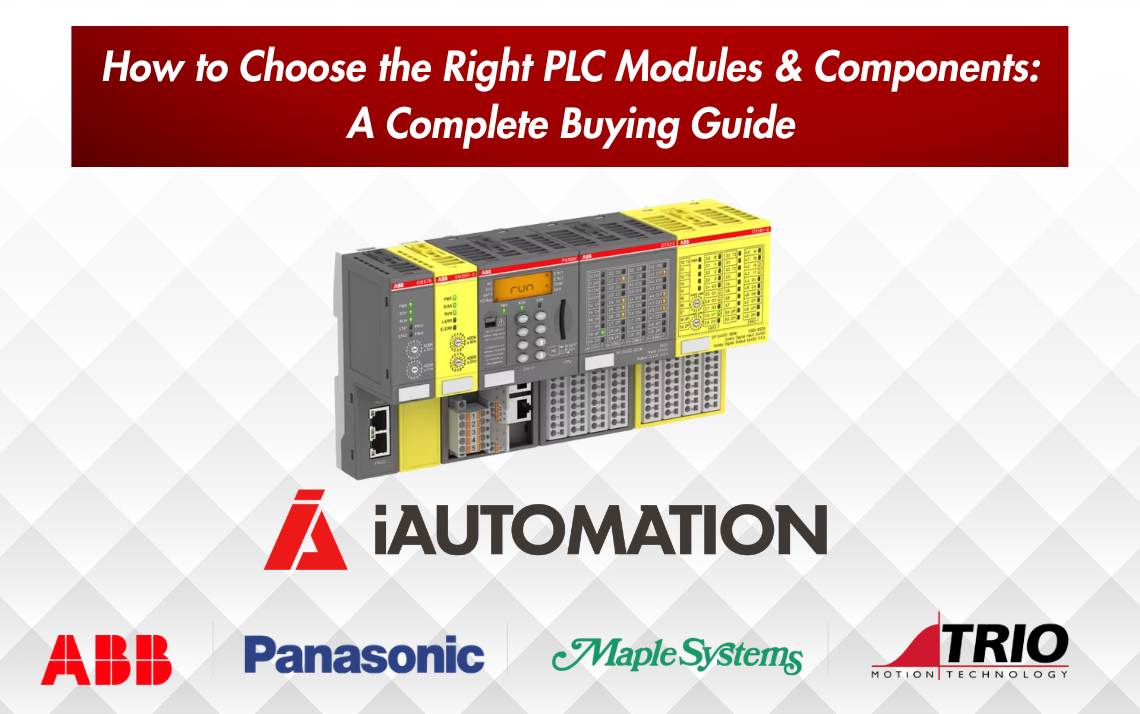
The most affordable place to buy PLC modules and components is usually an authorized automation distributor such as iAutomation. There, the right-sized controller, matched I/O, current firmware, and engineering support come in one order, and you avoid the hidden costs of the wrong part. The cheapest CPU on a search page rarely gives you the lowest installed cost. Software licenses, extra modules you didn’t plan for, freight, and a missed startup date add up fast.
We see the same pattern on panel builds every month. A buyer saves a few hundred dollars on a controller, then spends more on a comms card, a programming license, or a second shipment because the I/O count was off by four points. This guide walks through each PLC component, the main PLC tiers and what they cost to own, and a checklist for buying smart.
Core PLC Components
Every PLC system, from a palm-sized micro to a full chassis, is built from the same functional pieces. Knowing what each one does keeps you from overbuying or missing something.
CPU (Central Processing Unit)
The CPU runs the program, handles scan time, and holds memory for logic and data. When comparing CPUs, look at:
- Program and data memory
- Built-in ports (Ethernet, USB, RS-232/485)
- Maximum local and remote I/O count
- Motion features such as high-speed counters or pulse outputs
- Whether safety functions are integrated or need a separate controller
On compact PLCs, the CPU often includes built-in I/O and a power supply.
Power Supply
The power supply converts line voltage (typically 120/240 VAC) to the 24 VDC the controller and I/O need, or feeds the backplane in a rack system. Size it for the CPU, all modules, and field devices powered from the same supply, plus margin for inrush and future expansion. Voltage, current capacity, and circuit protection must follow the manufacturer’s data, UL 508A for industrial control panels, and the NEC (including Article 409 for industrial control panels). Have a qualified engineer confirm sizing on any new panel design.
Input Modules
Input modules bring field signals into the PLC.
- Digital inputs: read on/off devices such as pushbuttons, limit switches, and proximity sensors. Match sinking vs. sourcing (NPN vs. PNP) to your sensors.
- Analog inputs: read continuous signals such as 4–20 mA, 0–10 V, RTD, or thermocouple from transmitters and temperature probes.
- Specialty inputs: high-speed counter and encoder modules handle fast pulse trains.
Output Modules
Output modules drive field devices.
- Relay outputs: switch AC or DC loads and tolerate mixed voltages, but have slower switching and finite contact life.
- Transistor (DC) outputs: switch quickly and last longer, making them the choice for solenoids, indicators, and pulse outputs.
- Analog outputs: send 4–20 mA or 0–10 V to drives, valves, and positioners.
Check current per point and per common, not just the point count.
Communication Cards
Communication modules connect the PLC to HMIs, drives, remote I/O, and plant systems. Common protocols include EtherNet/IP, PROFINET, Modbus TCP/RTU, EtherCAT, and OPC UA. Some CPUs build these in. Others need an add-on card, which is one of the most common line items buyers forget to budget.
Rack/Chassis & Backplane
In modular and rack-based systems, the backplane carries power and data between the CPU and modules. A chassis is sized by slot count; rackless modular systems snap modules together side by side on DIN rail. Leave spare slots for expansion. Adding a second rack or expansion adapter later costs more than a larger chassis would have cost up front.
Where Can You Find Affordable PLC Modules and Components for Sale?
Buy from an authorized distributor that can match the controller tier to your application, confirm compatibility across CPU, I/O, and comms, and support you after the sale. Affordability starts with picking the right tier of PLC. Here is how the main categories compare.
Nano and Compact Micro PLCs (Fixed I/O)
- Standout Feature: CPU, power, and I/O in one DIN-rail unit, typically 8–40 points. For example, the Maple Systems PLC-FB0808P has 8 digital inputs and 8 digital outputs, Ethernet or serial communication, high-speed counters, and pulse outputs.
- Value: Lowest entry cost, and many come with free programming software. Maple Systems’ MapleLogic is free and includes simulation.
- Fulfillment: Small standalone machines, pump skids, and retrofits where the I/O count is known and won’t grow much. Maple Systems is featured in iAutomation’s PLC category.
Expandable Micro PLCs (CPU + Snap-On I/O)
- Standout Feature: A compact CPU with built-in I/O plus slots for side-mounted expansion modules, analog cards, and comms.
- Value: You pay only for the I/O you need today, and you can add points later without replacing the CPU.
- Fulfillment: OEM machines with option packages, and small lines where I/O will grow over the life of the equipment.
Modular PLCs (Rackless, DIN-Rail Systems)
- Standout Feature: Separate CPU, power, and I/O modules that join over an internal bus, often with several networks on the CPU. Examples include ABB’s AC500 family and Panasonic’s FP series; both brands appear in iAutomation’s PLC category.
- Value: Higher I/O counts, better diagnostics, and more memory than micros, without the cost of a full chassis.
- Fulfillment: Mid-size machines, packaging lines, and process skids needing mixed digital, analog, and motion I/O.
Rack-Based (Chassis) PLCs
- Standout Feature: A chassis and backplane with high slot counts, hot-swap modules on many platforms, and redundancy options.
- Value: The highest up-front cost, but the best scalability, lifecycle support, and serviceability for large systems.
- Fulfillment: Plant-wide control, large process systems, and facilities standardized on one platform. Contact iAutomation for availability on specific rack-based platforms.
Budget Import Controllers
- Standout Feature: Very low sticker prices on generic or lightly branded PLCs sold online.
- Value: Tempting for a hobby project or a test bench. For production, look hard at documentation, firmware updates, spare-part availability, and certifications. A UL 508A panel needs components with the proper UL listing or recognition.
- Fulfillment: Prototypes and non-critical test fixtures. For equipment that ships to a customer or runs a production line, a supported brand through an authorized distributor usually costs less over the life of the machine.
Safety note: If the application needs safety functions such as e-stops, guarding, light curtains, or safe speed, don’t try to handle them in a standard PLC. Look at Safety PLCs or safety relays rated for the required performance level or SIL, and validate the design against ISO 13849-1 or IEC 62061.
Industrial Surplus, Used & Refurbished Modules
Used and refurbished modules have a place, mainly for keeping legacy equipment running. Before you buy, weigh these points:
- Good fit: replacing a failed module on an obsolete platform while a migration is planned, or stocking a spare for a machine that must run until end of life.
- Risks: unknown hours and storage conditions, firmware mismatches, missing or non-transferable software licenses, and warranty terms that vary widely by seller.
- Counterfeits: high-demand modules are counterfeited. Buy from a source that can document where the part came from.
- Plan the exit: if you’re buying used parts because the platform is discontinued, that’s the signal to budget a migration. An engineering partner can scope the move to a current platform. Speak with an iA rep if you find yourself without an exit plan!
Open-Source & Developer Hardware
Arduino- and Raspberry Pi-based industrial controllers have made low-cost, programmable hardware easy to get, and some now support IEC 61131-3 languages.
- Where they fit: training, proofs of concept, data collection, and non-critical monitoring.
- Where to be careful: production control of machinery. Check for industrial temperature ratings, DIN-rail mounting, 24 VDC I/O, UL listing, noise immunity, and long-term availability before designing one into a machine.
- Middle ground: if you like the flexibility of open platforms, a CODESYS-based industrial controller gives you IEC 61131-3 programming on hardware built for the panel.
Tips to Save Money Sourcing in the US
Avoid License Traps
The hardware price is only part of the cost. Before you buy:
- Check the software cost. Some platforms need paid programming software, sold as annual subscriptions or perpetual licenses by edition. Others, including several compact PLC lines, offer free software.
- Match the edition. Confirm the edition you’re quoted supports your CPU family and the features you need, such as safety, motion, or redundancy. A lower-tier edition may not open the project you need to edit.
- Watch the extras. Some features are licensed separately: extra communication protocols, OPC UA servers, web visualization, or runtime licenses on PC-based controllers.
- Used hardware gotcha. A second-hand CPU won’t come with software, and some licenses are tied to the original purchaser.
Factor in Freight
- Consolidate orders. Several small shipments cost more than one complete bill of materials.
- Watch the heavy items. Chassis, large power supplies, and enclosures can trigger LTL freight; lithium backup batteries may have shipping restrictions.
- Check lead times before you commit. An expedited shipment can wipe out whatever you saved on a cheaper part.
- Buy domestically when you can. Ordering from a U.S. distributor avoids import duties, customs delays, and currency risk on overseas purchases.
More Ways to Cut Total Cost
- Right-size the I/O. Count every point, add 10–20% spare, and stop there.
- Standardize. One platform across machines means fewer spares, one software license, and faster troubleshooting.
- Check lifecycle status. Confirm the product line is active, not “mature” or discontinued, before you design it in.
- Bundle with the panel build. Buying components as part of a UL 508A panel build consolidates sourcing, testing, and documentation.
Key Buying Considerations
System Architecture
Decide first whether you need a standalone controller or a distributed system. Local I/O in one cabinet suits a compact machine. Remote I/O over EtherNet/IP, PROFINET, or EtherCAT cuts field wiring on long conveyors and large skids. Think about scan-time needs, motion axes, redundancy, and whether safety is integrated or separate.
I/O Signal Types
Build an I/O list before you shop. For each point, record:
- Digital or analog
- Voltage (24 VDC, 120 VAC)
- Sinking or sourcing
- Signal range (4–20 mA, 0–10 V, RTD, thermocouple)
- Any high-speed or isolation needs
Group the points by type to size modules and leave spares on each.
Network Connectivity
List every device the PLC must talk to: HMIs, VFDs, servo drives, robots, barcode readers, SCADA, and MES. Choose a controller whose built-in ports or add-on cards support those protocols natively. A protocol gateway works, but it adds a failure point and a line item.
Common Search Terms, and What They Actually Mean
Buyers phrase the same need many ways. Here’s what the common terms usually point to and what to watch for.
| Search term | What buyers usually mean | What to watch for |
|---|---|---|
| Affordable PLC modules for sale / low-cost PLC components | Compact micro PLCs and add-on I/O at entry-level prices | Total cost including software, comms, and freight, not just the unit price |
| PLC expansion modules / PLC I/O modules for sale | Add-on digital, analog, or specialty I/O for an existing CPU | Exact CPU family compatibility, firmware version, and max modules per CPU |
| Budget PLC systems / cheap industrial PLCs / PLC starter kits | A CPU, I/O, power supply, and software bundle for a small machine or for training | Whether the kit is industrial-rated and UL listed, or meant for training only |
| Used PLC modules | Surplus or refurbished parts, usually for legacy equipment | Provenance, warranty, license transfer, and a migration plan |
| PLC components suppliers USA / PLC hardware distributors | A domestic source for new hardware with support | Authorized status, stock, lead times, and engineering help |
Where to Buy PLC Modules & Components: Explore iAutomation’s Product Catalog
iAutomation is an authorized industrial automation distributor with engineering and UL 508A panel-building capability, headquartered in Franklin, MA, with facilities in Florida and Wisconsin. Browse iAutomation’s Product catalog for controllers, I/O, HMIs, networking, power distribution, and enclosures. Or go straight to the PLC and Safety PLCs categories.
When you send us an I/O list or a bill of materials, our team can help you:
- Pick the right PLC tier and confirm compatibility across CPU, I/O, and comms
- Consolidate the order to reduce freight
- Build the controller into a tested panel
Conclusion
Affordable PLC hardware means the lowest installed cost, not the lowest sticker price. Start with an accurate I/O list and a clear architecture, then choose the smallest PLC tier that covers today’s points plus sensible spares. Confirm software and license costs before you buy, and consolidate the order to control freight. Buying new from an authorized distributor gets you current firmware, documented provenance, and support when something doesn’t work at startup.
FAQs
A PLC system has a CPU, a power supply, input modules, output modules, and usually communication modules. Modular and rack-based systems add a chassis or backplane that connects everything. Compact PLCs combine several of these in a single unit.
For a small machine with a fixed, modest I/O count, a compact micro PLC is usually the cheapest and simplest option. If you expect the I/O to grow, or you need mixed analog, motion, and several networks, an expandable micro or modular PLC is worth the higher starting cost.
Used modules can work for keeping legacy equipment running, but they carry risks: unknown condition, firmware mismatches, limited warranty, and counterfeits. They also rarely include software licenses. For new equipment, buy new parts from an authorized source.
A common rule of thumb is 10–20% spare I/O on each signal type, plus at least one open slot or expansion position. That covers field changes during commissioning and small upgrades without reworking the panel.
If the machine’s risk assessment calls for safety functions such as e-stops, guard interlocks, or light curtains, you need safety-rated components. That can be a safety relay for simple circuits or a safety PLC for complex ones. A standard PLC shouldn’t perform safety functions. Validate the design to ISO 13849-1 or IEC 62061.
Have an I/O list or a bill of materials ready? Send it to us and we’ll match the right PLC tier, check compatibility across modules and software, and quote the hardware alone or built into a UL 508A panel. Talk to a Specialist today!