OEMs are under constant pressure to deliver higher-performing machines while reducing development timelines. Customers expect equipment that is faster, more flexible, easier to maintain, and ready for production with minimal commissioning delays. At the same time, engineering teams are being asked to manage increasing system complexity, tighter project schedules, and growing demands for connectivity and data visibility.
Motion control architecture often plays a major role in determining how quickly a machine moves from design to deployment. Traditional multi-vendor motion platforms can create integration challenges that consume engineering resources and extend commissioning schedules.
Modern servo motion systems address many of these issues by simplifying hardware integration, communication, configuration, and startup. Platforms like the Kollmorgen Essentials™ Motion System are specifically designed with this goal in mind—offering performance-matched components, multi-fieldbus support, and guided commissioning tools in a unified, ready-to-deploy package. By reducing complexity throughout the machine lifecycle, OEMs can accelerate development, shorten commissioning times, and improve overall project execution.
Why traditional motion systems slow machine development
Many machine builders still work with motion architectures that combine components from multiple suppliers. While these systems may provide flexibility, they often introduce integration and support challenges that increase engineering effort.
Common challenges
- Complex integration requirements
- Multiple communication protocols
- Long commissioning cycles
- Difficult servo tuning
- Increased wiring complexity
- Managing components from different vendors
Each additional component, software package, or communication layer introduces another variable that must be validated and supported. Engineers frequently spend significant time resolving compatibility issues, configuring network communication, tuning axes, and troubleshooting startup problems.
As project complexity increases, these tasks can delay machine delivery and increase both development and operational costs.
The shift toward simplified servo motion systems
Machine builders are increasingly moving toward integrated motion platforms that combine motors, drives, communication networks, safety functions, and software into a more unified architecture.
Rather than treating every motion component as a separate engineering task, these platforms are designed to reduce integration effort from the beginning.
Key advantages
- Pre-engineered system architecture
- Simplified hardware compatibility
- Faster deployment and setup
- Reduced engineering effort
- Improved scalability
For OEMs, the appeal is straightforward. Less time spent integrating and troubleshooting motion components means more time focused on machine functionality, performance optimization, and customer requirements.
As machine automation systems become more connected and data driven, simplified motion platforms provide a practical way to manage increasing complexity without increasing engineering workloads.
Features that help accelerate machine deployment
Several technical features contribute directly to faster machine development and startup.
Integrated servo motors and drives
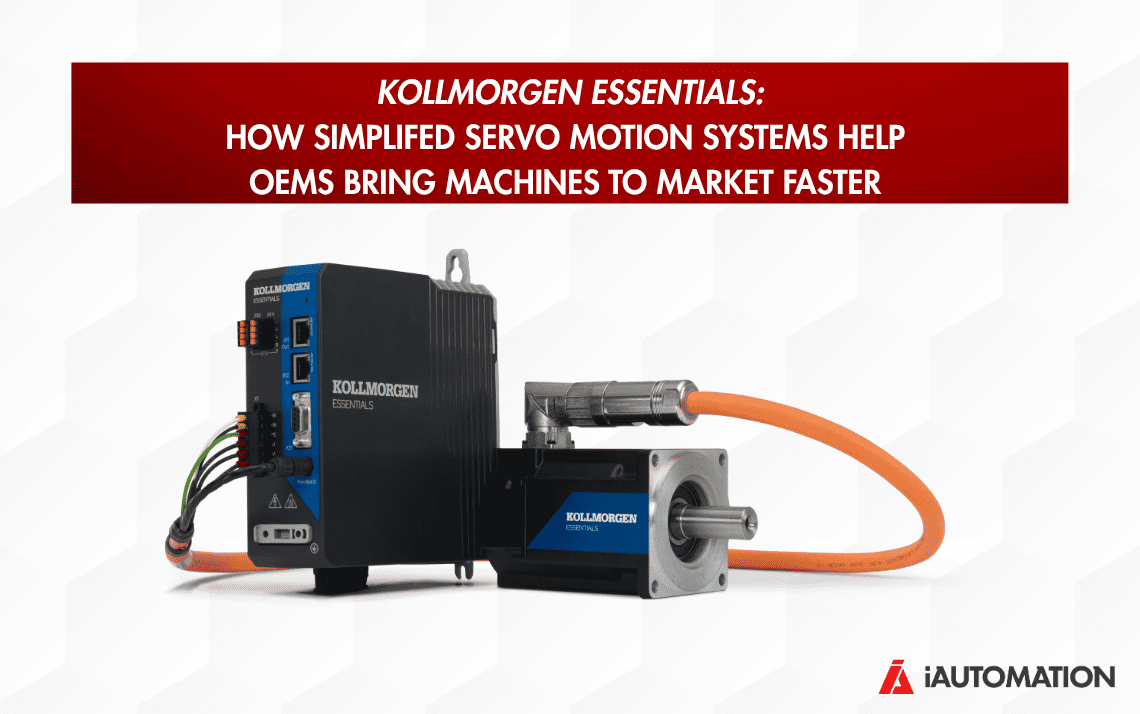
Performance matched motor and drive combinations eliminate much of the uncertainty associated with component selection and integration. The Kollmorgen Essentials™ Motion System, for example, pairs its KEM servo motor series with the KED servo drive—components engineered and validated together from the ground up.
When motors, drives, and feedback systems are designed to work together, engineers spend less time validating compatibility and tuning performance. This approach can improve reliability while reducing the risk of commissioning issues caused by mismatched components.
Integrated servo motion systems also simplify procurement and support by reducing the number of vendors involved in the project.
Multi-fieldbus communication support
Machine builders often serve customers across different industries and geographic regions, each with preferred communication standards.
Support for multiple industrial Ethernet motion control protocols helps simplify machine standardization, including:
- EtherCAT
- EtherNet/IP
- PROFINET
With native support for multiple networks, OEMs can deploy similar machine architectures across different customer environments without significant redesign efforts. The Kollmorgen Essentials™ KED drive supports all three of these protocols natively, eliminating the need to stock or specify different drive variants by region.
Single cable connectivity
Traditional motor installations often require separate power and feedback cables, increasing wiring complexity and installation time.
Single cable solutions reduce the number of connections required between the drive and motor. Kollmorgen’s Essentials™ platform uses a single rotatable connector that combines motor power, brake, and feedback into one cable—simplifying both installation and long-term maintenance. Fewer cables mean:
- Faster installation
- Reduced cabinet and machine wiring
- Simplified maintenance
- Lower risk of wiring errors
For large machines with multiple axes, these savings can become significant during both assembly and commissioning.
Built-in safety features
Machine safety requirements continue to expand across industrial automation applications. Built-in safety capabilities can simplify machine design while supporting compliance with applicable safety standards.
Faster commissioning with modern motion software
Hardware simplification alone does not eliminate commissioning challenges. Software tools play an equally important role in reducing startup time and improving engineering productivity.
Modern motion control automation platforms increasingly provide guided workflows that help engineers configure, tune, and validate systems more efficiently. Kollmorgen’s WorkBench software—a common programming environment across all of Kollmorgen’s drives—offers a familiar interface for seasoned users, while its Express Setup environment is designed to get drives configured and running in 20 minutes or less, making it especially accessible for newcomers without deep motion expertise.
Common software capabilities include:
- Simplified setup workflows
- Guided commissioning tools
- Auto tuning capabilities
- Diagnostics and troubleshooting tools
- Real-time monitoring and performance analysis
These features help reduce the time required to bring axes online and verify machine operation.
Commissioning improvements typically include:
- Faster drive configuration
- Reduced manual tuning effort
- Quicker fault identification
- Less time spent troubleshooting communication issues
- Faster validation of machine performance
- Reduced startup risk for complex systems
For OEMs managing aggressive project schedules, reducing commissioning time by even a few days can have a measurable impact on delivery timelines.
How OEMs benefit from reduced motion system complexity
Simplifying motion architecture affects more than just engineering efficiency. It influences machine deployment, support, maintenance, and long-term operational performance.
Benefits include
- Lower engineering effort
- Faster machine startup
- Reduced inventory requirements
- Simplified maintenance
- Improved production efficiency
- Better scalability for future expansion
Standardized motion platforms allow engineering teams to reuse proven architectures across multiple machine designs. This approach can reduce design cycles, improve supportability, and simplify technician training.
Over time, reduced complexity contributes to lower total ownership costs and stronger return on investment for both OEMs and end users.
Applications that benefit from simplified motion systems
Many machine types can benefit from integrated servo motion technologies.
Packaging machinery
Packaging automation motion systems rely on precise synchronization between conveyors, feeders, cutters, sealers, and labeling equipment.
Simplified motion architectures help maintain coordinated movement while reducing commissioning effort and simplifying machine maintenance. Faster startup and changeover capabilities are particularly valuable in high throughput packaging environments.
Warehouse automation
Warehouse automation systems often require coordinated motion across multiple machine elements and distributed equipment.
Common applications include:
- Conveying systems
- Sorting applications
- Storage automation
- Material handling systems
Integrated motion platforms help simplify deployment while supporting the high availability requirements common in logistics and fulfillment operations.
Material forming and cutting applications
Forming, cutting, and processing equipment depends on accurate motion synchronization and repeatable positioning performance.
Servo motion systems with integrated tuning and diagnostics capabilities can help maintain consistent motion quality while reducing setup and maintenance requirements.
General industrial automation
Many industrial machines require flexible motion solutions that can adapt to changing production demands.
Simplified motion platforms support a broad range of automation applications, allowing OEMs to standardize on a common architecture while maintaining flexibility across machine designs.
Choosing the right motion control partner
Technology selection is only one part of a successful automation strategy. The long-term value of a motion platform also depends on the supplier’s ability to support machine builders throughout the product lifecycle.
Important considerations include:
- Product reliability
- Technical support resources
- Software ecosystem maturity
- Scalability across machine platforms
- Global compatibility
- Long term product availability
A motion control partner should provide tools and support that help engineering teams solve problems efficiently, reduce development risk, and maintain consistent machine performance across multiple deployments.
Organizations that offer integrated hardware, software, networking, and support resources often simplify both initial implementation and ongoing machine support. Kollmorgen—with over 100 years of motion experience and a complete ecosystem spanning motors, drives, controllers, cables, and software—is one such partner. The Kollmorgen Essentials™ Motion System was designed specifically to give OEMs a faster, more confident path to market without sacrificing the performance and reliability Kollmorgen is known for.
Conclusion
As machine complexity continues to increase, OEMs need motion solutions that help reduce engineering effort rather than add to it. Simplified servo motion systems streamline integration, reduce commissioning time, and support faster machine deployment without sacrificing performance.
Integrated architectures, multi-network communication support, single cable connectivity, built in safety functions, and modern commissioning software all contribute to shorter development cycles and more efficient machine delivery.
For OEMs looking to bring machines to market faster, simplifying motion control infrastructure can be one of the most effective ways to reduce project risk, improve operational efficiency, and build scalable automation platforms for future growth.
Ready to simplify your motion architecture? Contact iAutomation to learn how the Kollmorgen Essentials™ Motion System can help accelerate your next machine development project.