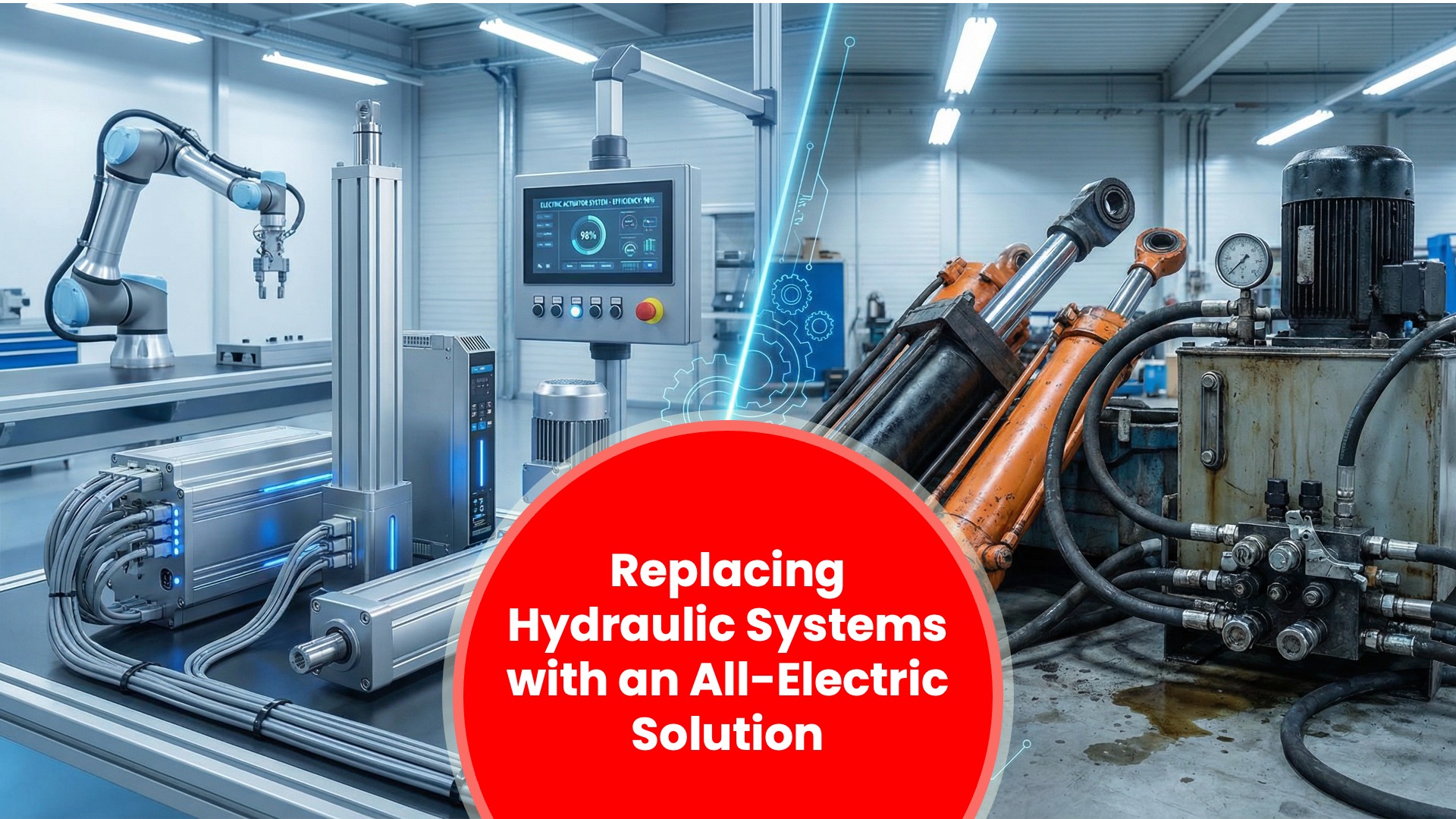
Industrial automation has come a long way since the early days of mechanical and hydraulic systems. For decades, hydraulic technology has been the backbone of heavy machinery, offering high force, robustness, and simplicity. Hydraulics have provided the muscle behind countless industrial operations such as presses, injection molding machines, lifts, and robotic arms.
However, the shift toward electrification in manufacturing has made companies evaluate electric actuators vs hydraulics for efficiency, precision, and sustainability. In this blog, we explore why organizations are moving away from hydraulics, the benefits of electrification, practical considerations for implementation, and strategies for a successful transition.
Limitations of Hydraulic Systems
Hydraulic systems have undeniable advantages. They deliver tremendous force, are relatively simple to design for certain applications, and have a decades long record of success. Yet, they come with inherent limitations.
1. Energy Inefficiency
Hydraulic systems rely on pumps to generate pressurized fluid, which then drives actuators or cylinders. Even with modern designs, a significant portion of energy is lost as heat during fluid compression and flow. This inefficiency increases operational costs and necessitates cooling systems to prevent overheating, adding maintenance requirements.
2. Maintenance Challenges
Hydraulic systems demand regular maintenance to ensure reliability. Leaks, pump failures, fluid contamination, and seal wear are common issues. Even minor leaks can result in costly downtime, fluid disposal concerns, and environmental hazards. Over time, these systems can become a liability if maintenance is neglected or poorly managed.
3. Precision and Control Limitations
Hydraulics excel in raw force but often lack fine control. Variations in fluiis veryd viscosity, temperature, and pressure can introduce inconsistencies in motion, making precision positioning and repeatability very difficult. This is a significant drawback in modern manufacturing where high-accuracy processes are required.
4. Environmental and Safety Concerns
Hydraulic fluids are typically petroleum-based, presenting risks of leaks, spills, and contamination. Handling, disposal, and regulatory compliance add hidden costs and safety concerns. In industries with strict environmental standards, this can make hydraulic systems less desirable.
These drawbacks have prompted engineers to explore electric actuators against hydraulics for improved performance and reduced operational costs.
Why are All-Electric Systems Getting Popular?
All-electric systems leverage servo motors, electric actuators, and advanced control electronics to perform functions traditionally handled by hydraulics. These systems offer a wide range of advantages:
1. Energy Efficiency
Electric actuators consume energy only when performing work, unlike hydraulic pumps that operate continuously. This leads to substantial energy savings, especially in machines with intermittent duty cycles. Additionally, regenerative technologies in modern electric drives can recover energy, further improving efficiency.
2. Precision and Repeatability
Servo motors and electric actuators provide highly accurate motion control, enabling precise positioning and repeatability down to microns. Unlike hydraulics, these systems are unaffected by temperature-induced viscosity changes or fluid pressure fluctuations, ensuring consistent performance.
3. Lower Maintenance
All-electric systems have fewer moving parts and do not require hydraulic fluids. This reduces maintenance requirements, eliminates the risk of leaks, and minimizes downtime caused by component failure. Predictive maintenance is also easier, as sensors can monitor performance and alert operators to issues before they escalate.
4. Environmental and Safety Benefits
By eliminating hydraulic fluids, electric systems remove the risk of spills and environmental contamination. They also reduce noise levels and improve workplace safety, creating a cleaner, quieter, and more sustainable operational environment.
5. Integration with Modern Automation
All-electric systems are easier to integrate with Industry 4.0 technologies, robotics, and advanced process controls. Networked controllers, data collection, and analytics allow for real-time monitoring, predictive maintenance, and system optimization capabilities that are more difficult to implement with hydraulic systems.
Evaluating the Feasibility of Transition
Transitioning from hydraulic systems to all-electric solutions is a strategic decision that requires careful evaluation. Not every hydraulic system can be directly replaced with electric actuators without adjustments, and a successful transition depends on the following aspects:
1. Assess Load, Speed, and Duty Cycle Requirements
The first step is to analyze the mechanical demands of your existing hydraulic system. You must consider the following aspects:
- Peak force and torque requirements: Determine the maximum force your hydraulic cylinders currently deliver. This helps in selecting high-force electric actuators that can match or exceed performance.
- Speed and acceleration: Hydraulic systems are often capable of rapid motion. Electric actuators must be able to replicate or improve cycle times without compromising safety or precision.
- Duty cycles: Continuous or heavy-duty applications may require specialized motors, cooling, or multiple actuators in parallel to avoid overheating or wear.
A detailed assessment ensures that the new electric system can meet all operational demands reliably.
2. Retrofit vs. Full System Redesign
Once mechanical requirements are understood, you must select whether your manufacturing unit needs a retrofit or a full redesign. You must choose the right design by considering the following aspect:
- Retrofit Redesign: Ideal for machines that are structurally sound and where hydraulic actuators can be directly replaced by electric equivalents. Retrofitting minimizes downtime and initial investment. For example, replacing a hydraulic press cylinder with a matched electric linear motion system can often be done with minor frame or mount modifications.
- Full Redesign: Necessary for older machines, complex hydraulic circuits, or where optimization of energy efficiency and precision is a priority. A full redesign allows for better integration with modern servo drives, motion controllers, and automation software.
3. Control System Compatibility
Electric systems rely heavily on precision motion control electronics. This means your existing PLCs, drives, or feedback devices may need upgrades or replacements. You must consider the following aspects:
- Interface compatibility: Ensure sensors, encoders, and controllers can communicate seamlessly with the new electric actuators.
- Software integration: Motion profiles, synchronization, and safety limits must be reprogrammed to match the capabilities of the electric system.
- Feedback systems: High-precision operations often require closed-loop control with encoders or laser positioning systems to replicate or exceed hydraulic performance.
4. Space and Mechanical Constraints
When replacing hydraulic systems with electric solutions, it’s important to recognize that electric actuators and linear motion systems often differ in size, shape, and mounting requirements compared to traditional hydraulic cylinders.
A careful evaluation of these physical differences is critical to ensure a smooth transition and reliable operation. You must consider these aspects:
- Mounting positions and stroke lengths: Verify footprint, mounting patterns, and required stroke lengths.
- Alignment with mechanical linkages or tooling: Ensure proper alignment with existing linkages and tooling.
- Clearance for cabling, controllers, and maintenance access: Allow space for power/feedback cables and maintenance access.
- Mechanical adapters and custom mounts: Use mechanical adapters or custom brackets where needed.
- Weight and Load distribution: Check load distribution and structural support requirements.
By carefully considering these mechanical constraints, manufacturers can avoid misalignment, excessive wear, and operational inefficiencies. This also ensures smooth hydraulic to electric conversion while maintaining operational efficiency.
5. Cost and ROI Analysis
Initial investment in electric actuators, servo drives, and control electronics can be higher than simply maintaining existing hydraulics. However, it’s crucial to calculate total cost of ownership (TCO):
- Energy savings: Electric systems consume power only when moving, unlike constantly running hydraulic pumps.
- Reduced maintenance costs: No hydraulic fluids, fewer seals, and fewer moving parts.
- Downtime avoidance: Increased precision and reliability reduce production losses.
A thorough ROI analysis often shows that while upfront costs are higher, long-term operational savings and efficiency gains make electrification a financially sound choice.
Potential Challenges and how to Mitigate Them
Changing from hydraulic to electric systems is not without challenges, but careful planning can mitigate risks. Here are some of the challenges and how you can mitigate them:
1. High-Force Applications
Hydraulic systems are traditionally favored for applications requiring extremely high force within a compact footprint, such as presses, clamps, and forming equipment. Replacing these systems with electric alternatives requires careful actuator selection and system design.
To address this challenge:
- Select high-force electric actuators designed for demanding industrial loads.
- Use gearboxes, ball screws, roller screws, or belt-driven mechanisms to amplify force output while maintaining accuracy.
- Consider multi-axis or parallel actuator configurations to distribute loads and achieve required force levels.
With proper engineering, electric systems can match or exceed hydraulic performance while offering superior control and repeatability.
2. Thermal Management
Electric motors and drives generate heat, especially in high-load or continuous-duty applications. Excessive heat can reduce efficiency, shorten component life, and cause unexpected shutdowns if not properly managed.
Effective thermal mitigation strategies include:
- Selecting motors and drives rated for the application’s duty cycle and ambient conditions.
- Implementing active or passive cooling solutions, such as forced air, heat sinks, or liquid cooling when necessary.
- Monitoring temperature through built-in sensors and feedback systems to enable alarms or automatic derating.
Proactive thermal management ensures consistent performance and extends the lifespan of electric actuation components.
3. Training and Upskilling
The transition from hydraulics to electric systems often requires a shift in skill sets. Maintenance teams accustomed to pumps, valves, and fluid systems must become proficient in electric drives, motion control, and diagnostics.
To ease this transition:
- Provide targeted training on electric actuator operation, motor control, and safety standards.
- Introduce personnel to software tools for diagnostics, tuning, and performance monitoring.
- Develop clear maintenance procedures and troubleshooting guides tailored to electric systems.
Well-trained teams are essential for minimizing downtime, improving system reliability, and maximizing the benefits of electrification.
4. Initial Investment
All-electric systems often require higher upfront capital investment compared to maintaining existing hydraulic equipment. Costs may include actuators, drives, controllers, mechanical modifications, and training.
To manage financial impact:
- Conduct a total cost of ownership (TCO) analysis that accounts for energy savings, reduced maintenance, lower downtime, and longer service life.
- Implement a phased conversion strategy, starting with pilot machines or non-critical systems to validate performance and ROI.
- Prioritize applications where energy consumption, maintenance costs, or precision limitations make electrification most advantageous.
In many cases, organizations find that the initial investment is offset by long-term operational savings and improved productivity. This makes the transition economically viable.
Steps for a Successful Transition
A structured approach is essential for a smooth and effective transition from hydraulic to all-electric systems. Here are the steps:
1. Conduct a System Audit
Assess existing hydraulic components, performance requirements, and operational constraints such as force, speed, duty cycle, space, and safety needs.
2. Evaluate Electrification Options
Decide whether retrofitting or a full redesign is most suitable. Select appropriate actuator types, motor ratings, and control architectures to meet performance goals.
3. Collaborate with Experts
Engage experienced automation distributors, OEMs, or system integrators to support system design, component selection, and integration.
4. Pilot and Test
Implement a small-scale or single-machine pilot to validate performance, identify risks, and refine system design.
5. Implement a Phased Rollout
Gradually expand electrification across machines, applying lessons learned to reduce downtime and manage costs.
6. Train Personnel
Train operators and maintenance teams on electric drive operation, diagnostics, and safety procedures to ensure reliable operation.
7. Monitor and Optimize
Use sensors and analytics to track performance, improve efficiency, and extend system life through continuous optimization.
Conclusion
Hydraulic systems have powered industrial operations for decades, but the transition to all-electric systems has become a strategic necessity. Improved energy efficiency, higher precision, reduced maintenance, environmental compliance, and seamless integration make electric systems an increasingly attractive choice for forward-looking organizations.
That said, replacing hydraulic systems is not a plug-and-play exercise. Successful implementation requires a detailed evaluation. When planned and executed correctly, however, electrification can dramatically enhance performance, lower operating costs, and future-proof industrial assets.
Organizations considering this transition benefit most by partnering with experienced automation experts who understand both legacy hydraulic systems and modern electric motion technologies. A phased, well-engineered approach minimizes risk, controls downtime, and ensures long-term value. iAutomation specializes in helping manufacturers and OEMs. We work as a strategic partner to deliver reliable, efficient, and scalable all-electric automation solutions. If you’re exploring the move from hydraulics to all-electric systems, contact us today to evaluate your needs and develop a conversion strategy that aligns with your operational goals and long-term growth plans.