
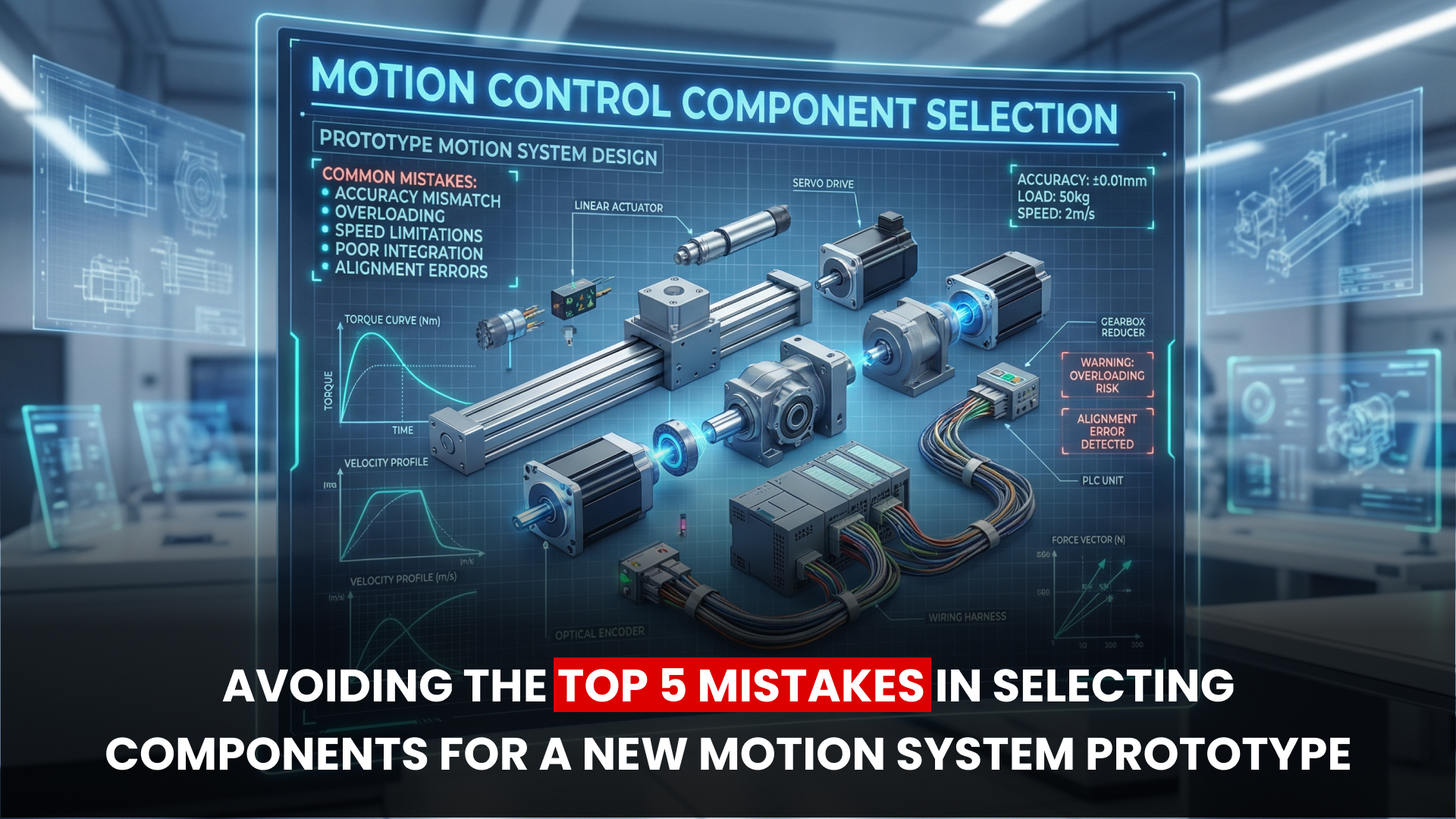
A new motion platform can look solid in CAD and still fail in the first prototype build. Most issues show up at the boundaries: motor to mechanics, drive to power quality, feedback to controller timing, and safety functions to the real operating mode. If you are building a prototype motion control system, component selection is not only about meeting peak specs. It is about integration behavior under real loads, real inertia, and real commissioning constraints.
This blog walks through five common mistakes that cause late-stage rework in a prototype motion control system, and what to do instead. The intent is practical: reduce commissioning time, protect mechanical hardware, and set up the prototype so it scales into production without redesign.
Define the component selection problem for a prototype motion control system
In a prototype motion control system, you are balancing three competing needs:
• Fast learning cycles: you want parts that commission predictably and expose useful diagnostics.
• Representative performance: you want the prototype to reflect the eventual machine behavior.
• Future scalability: you want the architecture to support changes without full replacement.
That means motion control component selection should be framed as a system decision, not a catalog decision. The motor, drive, feedback device, gearbox or belt, couplings, linear guides, controller cycle time, network, power distribution, and safety functions form a closed loop within the overall motion control system. Changes in one area can invalidate assumptions elsewhere.
If you treat these motion control components as independent, you can meet every datasheet line item and still end up with a prototype that hunts, overheats, trips on faults, or cannot be tuned within acceptable limits.
System view: what actually matters during motion control component selection
Before the “top five mistakes,” it helps to name the layers that interact in any prototype motion control system:
• Mechanical layer: load mass, inertia, stiffness, friction, backlash, compliance, resonance, mounting rigidity.
• Actuation layer: motor torque-speed curve, thermal limits, peak duration, encoder resolution, brake sizing if vertical.
• Power electronics layer: drive current limits, bus voltage, regen handling, line filtering, grounding and shielding.
• Control layer: controller update rate, servo loop bandwidth, interpolation, trajectory planning, jerk limits.
• Feedback layer: encoder type, absolute vs incremental, noise immunity, cable routing, resolution vs bandwidth trade-offs.
• Network layer: deterministic timing, distributed clocks, topology, EMI exposure.
• Safety layer: STO and safe motion options, safety I/O, mode switching, safe speed and safe stop behaviors.
Good motion system design usually starts here: treat the prototype like a mini production industrial motion control system, even if the mechanics are temporary.
Mistake 1: Sizing the motor from steady-state torque only
This is one of the most frequent common motion system mistakes in a prototype motion control system. Teams size from average torque, maybe add a margin, and move on. Then the first move profile exposes limits: acceleration demands, reflected inertia, and jerk-driven torque spikes, all of which are critical in proper servo motor sizing.
What goes wrong
• Acceleration torque dominates the profile, not steady-state load.
• Peak torque is available only for limited time due to thermal modeling.
• Drive current limits, not motor torque, become the real bottleneck.
• Overshoot and hunting show up because the system is underpowered relative to inertia.
What to do instead
During motion control component selection, build a simple torque-speed-time model to support accurate servo motor sizing:
• Separate torque into friction, load torque, and acceleration torque.
• Use realistic move profiles including jerk limits.
• Calculate reflected inertia at the motor shaft including gearbox ratio and efficiency.
• Verify the drive can supply required peak current without repeated overcurrent trips.
• Check RMS torque against motor thermal limits for the duty cycle.
For a prototype motion control system, also plan for test conditions that are harsher than nominal. Prototypes tend to run with imperfect alignment and higher friction. That is normal. Your sizing should tolerate it.
Mistake 2: Ignoring stiffness, backlash, and resonance until tuning
A servo loop does not fix mechanical compliance. It exposes it. Many prototype motion control system builds start with reasonable parts but a poor mechanical stiffness budget. You then spend days tuning around a resonance that is fundamentally mechanical , a core issue in motion system design.
What goes wrong
• Flexible couplings and long shafts introduce torsional compliance.
• Belt drives or gearboxes add backlash and ripple.
• Structural modes show up inside the control bandwidth.
• The system appears stable at low speed but becomes unstable at higher bandwidth.
What to do instead
Add mechanical dynamics to your motion system design tips checklist:
• Identify likely resonance points based on structure and transmission type.
• Keep compliant elements out of the primary torque path unless required.
• Choose gearboxes with backlash appropriate to positioning tolerance.
• Avoid mounting motors on thin plates or cantilevered brackets.
• Validate coupling selection against torque ripple and misalignment limits.
During motion control component selection, ask whether the chosen mechanics support the bandwidth you need. If you need fast settle times, you need stiffness. If you need high torque at low speed, watch for gearbox torsional compliance.
This is why “it tunes on the bench” is not enough. A prototype motion control system needs to tune on the real frame, with the real load and cable routing in place.
Mistake 3: Treating the feedback device as “just resolution”
Encoder selection in a prototype motion control system is commonly reduced to resolution and absolute vs incremental. Resolution matters, but signal integrity and timing often matter more in the first prototype, especially in industrial motion control environments.
What goes wrong
• High-resolution feedback increases noise sensitivity in poor grounding conditions.
• Encoder cable routing near motor power causes intermittent position errors.
• Controller and drive compatibility issues slow commissioning.
• Update rates and filter settings reduce effective bandwidth.
What to do instead
For motion control component selection, evaluate feedback as part of the loop:
• Confirm drive supports the encoder interface natively (BiSS, EnDat, SSI, incremental).
• Verify max feedback frequency vs the top speed you need.
• Plan cable shielding, grounding, and routing early.
• Decide whether absolute position is needed for homing reduction or safety mode recovery.
• Consider functional safety requirements if safe position or safe speed is relevant.
For industrial builds, it is also common to choose feedback that supports better diagnostics and easier troubleshooting. In industrial automation prototyping, commissioning speed is a real constraint. If you lose two days chasing an intermittent encoder fault caused by routing, the prototype schedule slips.
Mistake 4: Underestimating power quality, regeneration, and grounding
A prototype motion control system often gets built on a temporary power layout. Long cables, shared circuits, and quick grounding choices can turn into nuisance faults that look like control problems.
What goes wrong
• DC bus overvoltage trips during decel because regen is not handled.
• Line voltage dips cause undervoltage faults during acceleration.
• Improper grounding leads to encoder noise and network drops.
• EMI affects sensors and safety circuits, not only the servo loop.
What to do instead
Treat power and grounding as first-class design inputs during motion control component selection within your overall motion control system architecture:
• Calculate regen energy for worst-case decel and vertical axes.
• Add braking resistors or regen units when needed.
• Use appropriate line filters and reactors based on the drive vendor guidance.
• Implement a defined grounding strategy: star points, cabinet ground bar, shield termination practice.
• Separate motor power and feedback/network routing physically.
• Use proper cable types and gland practices for shielding continuity.
These are not “nice to have.” In a prototype motion control system, unstable power behavior can be mistaken for tuning instability, leading to wasted effort.
Mistake 5: Selecting components without a clear integration and validation plan
Many common motion system mistakes are not technical errors in a single component. They are integration errors across motion control components. A prototype motion control system needs a commissioning plan that matches the architecture.
What goes wrong
• Mixed vendors create unclear responsibility for interoperability issues.
• Network timing and distributed clock setup are not validated early.
• Safety functions are added late and force a redesign of I/O and drive selection.
• Diagnostic tooling is inconsistent across devices, slowing root cause analysis.
What to do instead
Build an integration checklist as part of motion system design tips:
• Confirm controller, drive, and network timing compatibility.
• Validate update rates, servo cycle time, and expected bandwidth.
• Confirm safety requirements early: STO minimum, and whether safe motion is required.
• Define what must be measured during commissioning: following error, torque, bus voltage, temperature, fault history.
• Plan for logging and repeatable test moves.
For industrial automation prototyping, the goal is not only to “make it move.” The goal is to generate data that lets you lock down the production design. That means selecting motion control components that support repeatable validation within a scalable motion control system.
Practical scenario: a packaging axis prototype that “worked” but could not scale
A common real-world case in a prototype motion control system is a rotary cutter or infeed axis that runs fine at 60 cycles per minute but fails at 120.
Typical root causes map directly to the mistakes above:
• Motor sized for average torque, not accel torque at higher throughput, a classic servo motor sizing issue.
• Belt compliance introduces resonance near the desired control bandwidth.
• Encoder noise appears only at higher speed due to routing near motor leads.
• Bus overvoltage trips during aggressive decel with no regen handling.
• Controller cycle time is too slow for the trajectory jerk profile.
This is why motion control component selection must be tied to the real throughput target and the real motion profile. Prototype success at low rate is not proof of scalability in a production motion control system.
Quick checklist to reduce risk in your prototype motion control system
Use this as a practical gate before you order parts for a prototype motion control system
- Mechanical dynamics reviewed: stiffness, backlash, coupling choice, mounting rigidity.
- Load model complete: inertia reflected, friction estimated, torque-speed-time calculated.
- Drive limits checked: peak current, continuous current, bus voltage range, regen plan.
- Feedback plan set: interface compatibility, routing, shielding, noise control.
- Network timing validated: cycle time, topology, EMI risk points.
- Safety included early: STO wiring, safe motion requirements if applicable.
- Commissioning plan defined: tuning approach, logging strategy, repeatable test routines.
Each item prevents a category of late-stage redesign in your motion control system deployment
Closing guidance
A prototype motion control system is a learning tool, but it still needs production-grade thinking. The fastest prototypes are the ones designed for predictable commissioning and clean integration. If you avoid the five mistakes above, your motion control component selection will support stable tuning, reliable diagnostics, and a clearer path from prototype to machine release within a robust industrial motion control environment.
If you want a second set of eyes on your architecture, talk to a specialist who can review the mechanical dynamics, power layout, and control timing together before you lock in components.