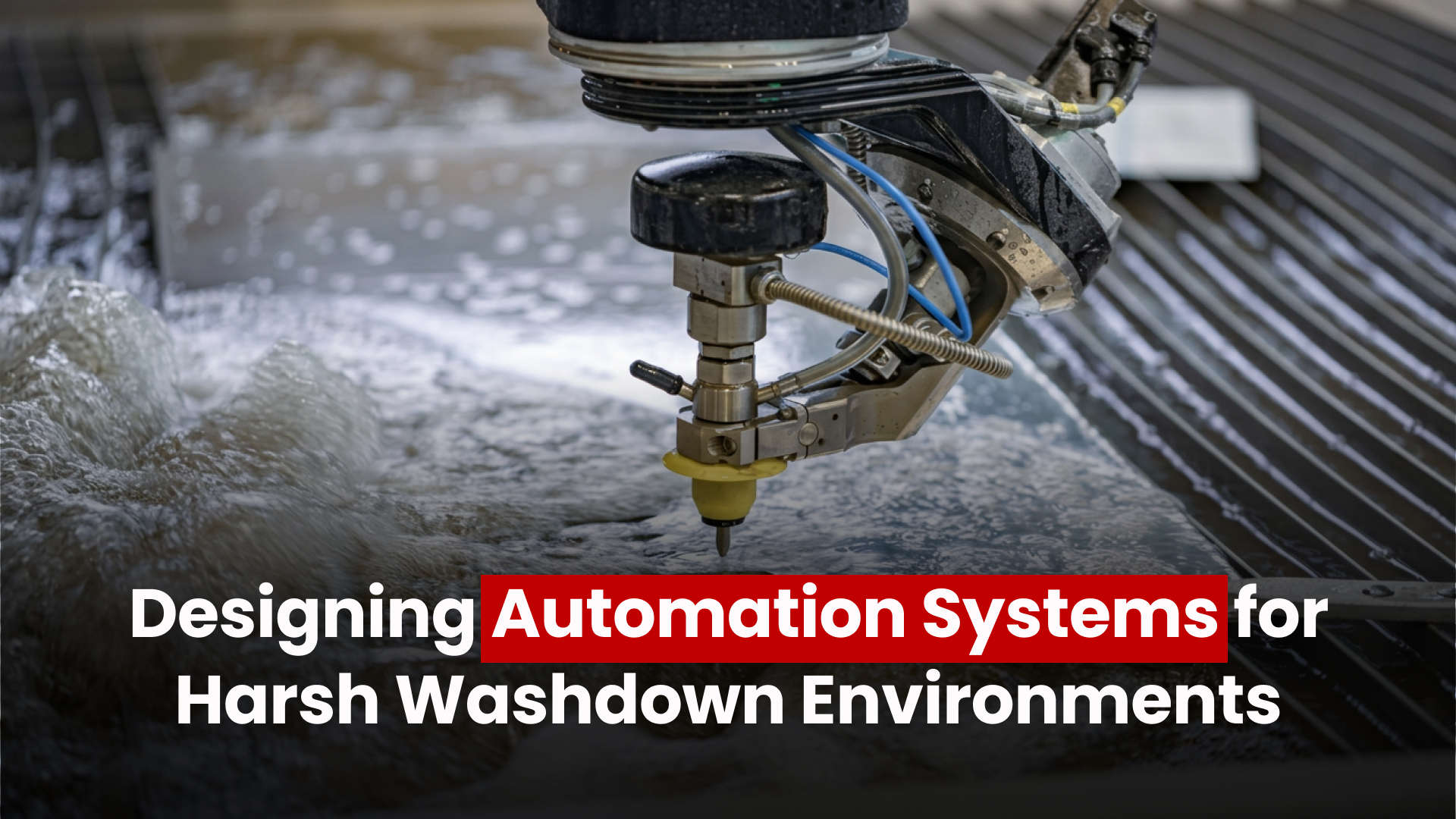
Food, beverage, and pharmaceutical production environments place unique demands on automation equipment. High-pressure washdowns, aggressive cleaning chemicals, temperature cycling, and strict contamination control requirements expose weaknesses in conventional industrial components very quickly.
In these environments, the issue is not simply whether a motor or sensor can function. The issue is whether the entire automation system can maintain performance, reliability, and hygienic integrity after repeated cleaning cycles over years of operation.
Washdown automation requires deliberate engineering decisions at the component, panel, and system level. It also requires alignment between mechanical design, controls architecture, and sanitation procedures.
Why Washdown Automation Requires Specialized Engineering
Harsh cleaning regimens are not occasional events in food-grade facilities. They are daily, sometimes per-shift, procedures that include:
- High-pressure water jets
- Elevated water temperatures
- Caustic or acidic cleaning chemicals
- Foam and sanitizer applications
- Manual scrubbing and rinse-down cycles
These processes challenge seals, coatings, cable entries, connectors, and mechanical interfaces. Components that perform well in dry industrial environments often fail prematurely in splash zones or direct washdown areas.
The most common failure modes include:
- Seal degradation leading to moisture ingress
- Corrosion of fasteners, shafts, and housings
- Contaminant accumulation in mechanical “catch points”
- Electrical shorts from water intrusion
- Increased downtime due to frequent replacement
Selecting washdown-ready automation components helps reduce these risks. However, component selection alone is not sufficient. Engineers must also consider:
- Mounting orientation
- Drainage paths
- Surface finish and geometry
- Cable routing and gland design
- Integration between field devices and control panels
iAutomation supports customers facing these challenges by providing a broad portfolio of washdown products designed for harsh cleaning regimens. More importantly, these products are positioned within a complete automation system framework, not as isolated parts.
Understanding IP Ratings in Washdown Environments
Ingress Protection ratings are often referenced but not always fully understood. In washdown applications, misunderstanding IP ratings can lead to under-specification or unnecessary cost.
An IP rating consists of two digits:
- First digit: protection against solid objects and dust
- Second digit: protection against water
The chart shown in the iAutomation washdown material breaks this down clearly.
From an engineering standpoint, several ratings are common in food and pharmaceutical environments:
IP65
- Dust tight
- Protected against water jets from any angle
This level is typically acceptable for indirect splash areas but not for direct high-pressure spray.
IP67
- Dust tight
- Protected against temporary submersion
Useful for equipment that may experience pooling or periodic immersion during cleaning.
IP68
- Dust tight
- Protected against permanent submersion under defined conditions
Less common in typical packaging lines but relevant in certain process environments.
IP69K
- Dust tight
- Protected against close-range, high-pressure, high-temperature spray downs
IP69K is generally required for components exposed to direct washdown with high-pressure nozzles and elevated temperatures.
Engineers should recognize that IP69K does not address chemical compatibility, material compliance, or hygienic geometry. A stainless housing with poor surface finish or improper gasket material may still fail despite a high IP rating. It’s also important to note that IP ratings are not cumulative—performance in one category does not guarantee protection in another. For example, while IP69K devices are designed to withstand high-pressure washdowns, they are not necessarily protected against continuous submersion like an IP68-rated device. IP ratings are one parameter within a broader hygienic design strategy.
Core Washdown Automation Components
A reliable washdown automation system integrates mechanical, pneumatic, electrical, and robotic elements that are each designed for exposure to water and cleaning chemicals.
The iAutomation washdown portfolio illustrates the range of components required for these systems.
Washdown Gearboxes
Washdown gearboxes are constructed from corrosion-resistant materials and use food-safe lubrication. This reduces the need for secondary enclosures or mechanical shielding.
Key design characteristics include:
- Stainless or coated housings
- Sealed shaft interfaces
- Smooth external geometry
- Lubricants compatible with food environments
Proper gearbox selection supports long-term reliability and reduces contamination risk around rotating equipment.
Washdown Pneumatics
Valve terminals and pinch valves made with FDA-compliant materials allow pneumatic control closer to the point of use.
For system designers, this provides several benefits:
- Reduced tubing length
- Faster response times
- Improved machine layout
- Simplified sanitation access
Material selection and seal compatibility are critical. Elastomers must withstand both cleaning chemicals and temperature cycling without embrittlement.
Washdown Motors
Motors are available in aluminum, stainless steel, and epoxy-coated designs intended for food contact and splash zones.
In practice, engineers should evaluate:
- Shaft seal design
- Cable entry sealing
- Thermal dissipation under sealed conditions
- Surface finish for cleanability
A motor that meets the IP requirement but traps moisture at the mounting interface can still create sanitation issues.
Hygienic Actuators
Electric and pneumatic actuators designed with smooth surfaces reduce contaminant catch points.
This is a mechanical design issue. Threads, exposed fasteners, and sharp transitions create locations for residue buildup. Hygienic actuators are intended to minimize these features.
Washdown Sensors
Proximity, safety, ultrasonic, and RFID sensors with ratings from IP66 to IP69K are commonly used in these environments.
For sensing devices, engineers should consider:
- Connector sealing integrity
- Cable overmold design
- Chemical compatibility of lens materials
- Mounting bracket corrosion resistance
Sensor failure is one of the most common causes of unplanned downtime in washdown packaging lines.
Fieldbus I/O Modules
Machine-mounted I/O modules with IP69K construction and Ecolab certification are designed to withstand harsh cleaning regimens.
Decentralized I/O reduces panel wiring complexity and can improve diagnostics. However, mounting location and cable management must support full drainage and avoid water pooling.
Operator Panels
Stainless steel HMI housings and membrane push buttons provide a sealed operator interface ready for stringent cleaning requirements.
In regulated environments, operator interfaces must balance usability with cleanability. Flat surfaces and sealed membranes help maintain hygiene while preserving repeatable operator control.
Hygienic Enclosures
Fully stainless enclosures with sloped tops and silicone gaskets are commonly used to protect control components.
The sloped geometry promotes drainage. Gasket selection influences long-term sealing performance under repeated wash cycles.
Washdown Conveyors
Conveyors designed with tool-less belt release allow cleaning under the belt without tension or tracking adjustments.
This is not only a sanitation benefit. It also reduces maintenance time and supports consistent belt alignment after cleaning.
Washdown Robots
Delta robots and collaborative robots that are NSF certified and ready for food handling are increasingly used in primary packaging and pick-and-place applications.
Robotic systems in washdown areas require:
- Sealed joint designs
- Hygienic cable routing
- Cleanable end-of-arm tooling
- Validation under cleaning cycles
Robotics can improve repeatability and throughput, but only when integrated with hygienic mechanical design and validated cleaning procedures.
Expanding Washdown Capabilities Through Strategic Partnerships
A washdown portfolio must evolve as standards, materials, and customer requirements change.
iAutomation continues to expand its washdown offering through strategic supplier partnerships. Festo is the latest supplier added to this portfolio, enhancing pneumatic and motion capabilities for hygienic environments.
This approach allows OEMs and system integrators to access proven technologies from established manufacturers while maintaining system-level compatibility and integration support.
The objective is not to present a catalog of parts. The objective is to assemble validated, interoperable solutions that support reliability in harsh cleaning environments.
From Components to Complete Washdown Automation Systems
Washdown automation is rarely a single-component decision. It is a system architecture decision.
iAutomation supports customers with:
- System integration and controls design
- Panel building with hygienic enclosure selection
- Robotics integration
- Motion and drive system engineering
- Fieldbus and decentralized I/O architecture
- Application-specific component selection
This system-level focus helps align mechanical, electrical, and control elements into a cohesive solution intended for long-term reliability and validation.
For OEM machine builders, this reduces integration risk. For plant managers and manufacturing engineers, it supports consistent uptime and predictable sanitation performance.
In regulated industries such as food and pharmaceuticals, documentation, traceability, and material compliance also play a role. Washdown automation components must align with FDA-compliant materials, NSF-certified robotics, and cleaning chemical compatibility.
Conclusion
Designing automation systems for harsh washdown environments requires more than selecting a high IP rating. Engineers must evaluate material compatibility, hygienic geometry, sealing strategies, and system integration.
Washdown gearboxes, motors, pneumatics, sensors, fieldbus I/O, operator interfaces, enclosures, conveyors, and robots each play a role in building a reliable system. When properly selected and integrated, these components help support repeatability, cleanability, and long-term operational control.
iAutomation provides a comprehensive washdown-ready portfolio and supports customers with full automation system integration. If you are evaluating a new machine design or upgrading an existing line for harsher cleaning requirements, consider discussing your application with an iAutomation specialist to review component selection and overall system architecture. Talk to a Specialist Today!